Selecting the Right CDMO Partner for What Comes Next

Establishing a collaboration with a contract development and manufacturing organization (CDMO) often begins with a specific requirement, such as a formulation, filling format, clinical batch, or commercial supply need. Yet the choice can shape technology transfer, regulatory milestones, shifting demand, packaging evolution, and security of supply across the product lifecycle.

Technical capability, quality, compliance, timelines, and cost remain essential when pharma and biotech companies assess potential CDMO partners. The differentiator is whether the partner can adapt as the program evolves and whether both organizations can make difficult decisions together. In short: select for what comes next.
What is Changing in the Way Pharma and Biotech Companies Select CDMO Partners?
Drug product development, manufacturing, and secondary packaging are increasingly interconnected. For injectables, decisions involving formulation, analytics, filling, packaging, devices, storage, and distribution can affect one another, while quality and regulatory expectations remain exacting across changing development stages and demand scenarios.
Selecting a CDMO is therefore as much about managing interfaces and change as it is about executing a defined scope. Technical and regulatory expertise need to be matched by transparency, flexibility, and a reliable operating relationship to support successful execution.
The ideal balance depends on the product and drug owner. A small early-stage biotech may prioritize guidance, the speed of learning, and a practical route into clinical supply; a commercial organization may emphasize reliable supply, capacity flexibility, cost efficiency, and lifecycle continuity. The evaluation should reflect those needs rather than rely on a one-size-fits-all scorecard.
Why is Traditional CDMO Due Diligence No Longer Enough?
Traditional due diligence is indispensable. Biopharma companies need to verify the potential partner’s quality system, relevant experience, technologies, capacity, and delivery plan. These assets can be evaluated through inspection history, customer audits, technical assessments, and financial and contractual reviews.
This evidence, however, only provides a temporary snapshot. The evidence confirms that systems and capabilities exist, but it may say less about how the organization responds when priorities shift; a technical issue emerges, or a timeline comes under pressure.
This gap needs to be fixed. Beyond compliance, pharma and biotech companies should examine operational behavior: how risks are communicated, decisions escalated, knowledge shared across departments, and the right experts mobilized.
Two questions remain crucial: Can the service provider perform the work, and can the partnership continue to perform when the work changes?
What Should Sponsors Evaluate Beyond Technical Capability?
A future-ready assessment should connect quality and regulatory maturity, lifecycle fit, operational resilience, governance, and strategic alignment rather than treat them as isolated checklist items (Figure 1).
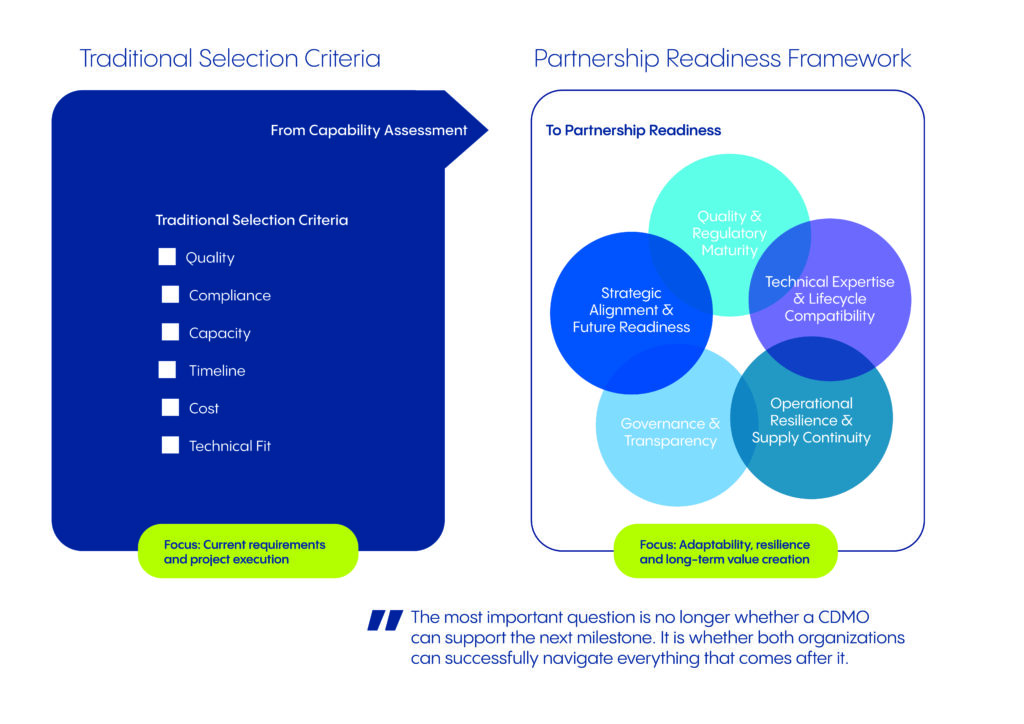
Quality systems remain the foundation, but drug owners should look beyond the existence of procedures. Sponsors should also examine how deviations, corrective and preventive actions, risk management, audits, and regulatory decisions connect in practice. The same lifecycle view should test whether the operating model can support plausible next stages, including scale-up, transfers, alternative presentations, packaging modalities, analytical needs, and device integration where relevant.
Supply chain security deserves explicit scrutiny. A drug owner should verify how the CDMO identifies and manages dependencies involving critical materials, suppliers, logistics, cold chain, utilities, and capacity. This verification includes the robustness of supplier qualification and monitoring, contingency planning, business continuity management, and the long-term approach to protecting security of supply. Scenario-based evidence is particularly valuable: how would the organization respond to shortages, transport disruption, an unexpected volume change, or the loss of a critical supplier? Operational resilience is not simply excess capacity; it is the combination of assets, processes, expertise, visibility, and decision-making that enables a responsible response.
Governance, transparency, and strategic alignment determine whether these capabilities can be used effectively. Biopharma companies need to clarify decision rights, escalation paths, and how quality, technical, supply, and commercial perspectives come together. Companies should also assess digital and automation maturity to determine whether connected systems, data integrity controls, process monitoring, analytics, and automated workflows improve visibility, consistency, traceability, and timely decision-making. Technology should be evaluated not as a showcase, but by how well it supports compliant operations and accountable human decisions. Finally, the CDMO’s investment priorities and operating horizon should align with the future needs of biopharma.
How Should Drug Owners Rethink Audits and Due Diligence?
A modern audit should assess how the organization operates — not only whether documentation exists. The most useful evaluation combines evidence from past performance with scrutiny of interfaces, behavior under pressure, and continuity.
Drug owners can ask for concrete examples: how the service provider investigated a significant deviation, governed a complex transfer, or evaluated a cross-functional change. The objective is not to uncover a flawless history, but to discover evidence of disciplined response, sound decisions, and organizational learning.
Paying particular attention to interfaces is also crucial because many challenges can arise between functions or organizations. Pharma and biotech companies need to examine handoffs throughout the process, including across development, manufacturing, quality, the CDMO and sponsor teams, and, where applicable, filling, secondary packaging, and device activities. Ownership should be unambiguous.
Scenario-based questions then reveal behavior under pressure. What happens if demand shifts materially, a packaging change occurs late, or quality, timeline, and supply priorities conflict? The answers indicate whether the potential partner understands the escalation routes and fosters genuine cross-functional decisions.
Finally, sponsors should assess continuity. Is expertise embedded in the organization, or does the program depend too heavily on a few individuals? How is knowledge documented and transferred? Strong relationships between individuals are valuable. Organizational depth makes them sustainable.
Which Metrics Provide the Most Meaningful View of a Future Partnership?
No single metric can predict partnership performance. A balanced view of historical outcomes and forward-looking indicators is needed to provide the best outlook.
Historical, or lagging, indicators establish a performance record. Depending on the scope, these may include inspection of outcomes, deviation and the investigation of performance, delivery reliability, transfer outcomes, and supply interruptions. The definitions and time periods must be comparable. Context is essential to offer a comprehensive analysis of the situation.
Leading benchmarks can be equally informative: the speed and quality of escalation, transparency in risk communication, stability and depth of the core team, cross-functional participation, clarity of decision rights, and the response to changed assumptions. Where relevant, sponsors can also examine system adoption, data availability, process visibility, and the effective use of automation. These indicators show how the partnership is likely to operate, not merely what it delivered in the past.
Cost should also be evaluated in context. A formal quotation is visible and easy to compare with competitors. The total impact of delayed decisions, repetitive work, supply disruption, or an unsuitable lifecycle setup is harder to calculate. Good selection processes therefore examine value, risk, and performance together rather than treating price as an isolated data point.
What are the Most Common Pitfalls During the Partner Selection?
A common mistake is selecting a service provider only for today’s milestone. An outsourcing partner may fit an immediate clinical requirement but be less suited to later scale, a different presentation, or commercial continuity. Pharma and biotech do not need certainty about every scenario, but they should test the most plausible ones.
Selection teams also tend to overweigh what is easiest to compare. Capacity, timelines, and price fit neatly into a table; governance quality, transparency, adaptability, and resilience require deeper investigation. An audit should therefore not be treated as a simple pass-or-fail event because a binary conclusion can obscure differences in quality maturity, risk ownership, and cross-functional behavior.
Critical stakeholders should be involved before core assumptions become difficult to change. The precise mix will vary, but regulatory, quality, analytical, packaging, device, procurement, supply, and commercial perspectives may all be relevant.
Personal chemistry should not be confused with partnership readiness. Trust matters, but it must be supported by clear responsibilities, explicit expectations, and a practical escalation model. The same balance applies to technology: automation and digital systems can reduce risk and improve visibility, while experienced people remain critical to interpreting information and making accountable decisions in a regulated environment.
At What Point Does a Supplier Relationship Become a Strategic Long-term Partnership?
Not when the contract uses the word “strategic.” And not simply because two companies have worked together for many years.
A supplier relationship becomes a strategic partnership when both organizations manage more than the contracted task. Risks are raised early. Relevant information is shared transparently. Decisions consider the product lifecycle, not only the next deadline. Both sides bring the appropriate expertise, accept clear responsibilities, and address adjustments together.
Strategic dialogue should also extend beyond a single product. When appropriate, the drug owner company and CDMO can exchange perspectives on the future pipeline, such as platform needs, capacity implications, and upcoming technology or presentation requirements. This exchange does not replace product-specific governance; it allows both organizations to anticipate dependencies and make enlightened investment and supply decisions.
Trust is the result of that behavior, growing when teams communicate openly, follow through on commitments, and handle difficult topics without delay. This trust does not eliminate disagreement; instead, it creates a way to resolve disagreement productively.
A simple truth: a real partnership is visible under pressure. When conditions remain stable, many operating models can appear effective. When assumptions change, the quality of governance, expertise, and communication becomes clear.
What Should Sponsors Ultimately Ask Themselves During CDMO Selection?
Sponsors should begin with the fundamentals. Does the potential partner deliver the right level of quality technical capability, regulatory understanding, digital and automation maturity, and supply infrastructure required for the product? Is the proposed scope realistic? Are roles, timelines, costs, critical dependencies, and continuity arrangements transparent?
Then, sponsors should look further. Can the operating model adapt as the product and broader pipeline evolve? Will supply chain risks be communicated early and managed through credible business continuity measures? Are decisions made at the right level and with the right functions involved? Does the organization have the depth to sustain the program, and are both sides prepared to invest the attention required for a long-term relationship?
The most important question is no longer whether a CDMO can support the next milestone; it is whether both organizations can successfully navigate everything that comes after it.
About the Author
Lars Hahn serves as the Senior Vice President Global Sales at Vetter where he is responsible for the company’s global sales activities. In this role, Lars leads the key account management, business development, customer project management as well as product management and marketing. He originally joined Vetter in 2022 as Vice President Key Account Management, leading the teams across North America, Europe, and Asia Pacific.
Prior to his roles at Vetter, Lars dedicated over 20 years in sales roles in the medical device and pharma industry as well as various outsourcing and procurement roles at large pharma and biotech companies such as B. Braun, Merck, Novartis, and Boehringer Ingelheim. His areas of focus included global sales, project management, procurement, and more. He began his career as a consultant for the chemical industry
Lars earned a degree in chemistry and business studies from the University of Münster, and stayed at the University of Kassel, Carnegie Mellon University, and the University of Göttingen during his course of studies before.
Vetter, a globally operating CDMO, headquartered in Ravensburg with production facilities in Germany, Austria, and the US, is a leading specialist in the production of life-saving injectable medications. With a wealth of experience and a highly dedicated team, the independent pharmaceutical service provider offers a wide range of critical services to pharma and biotech companies at every stage of their drug product journey.
Image Credit: © chee siong teh – stock.adobe.com