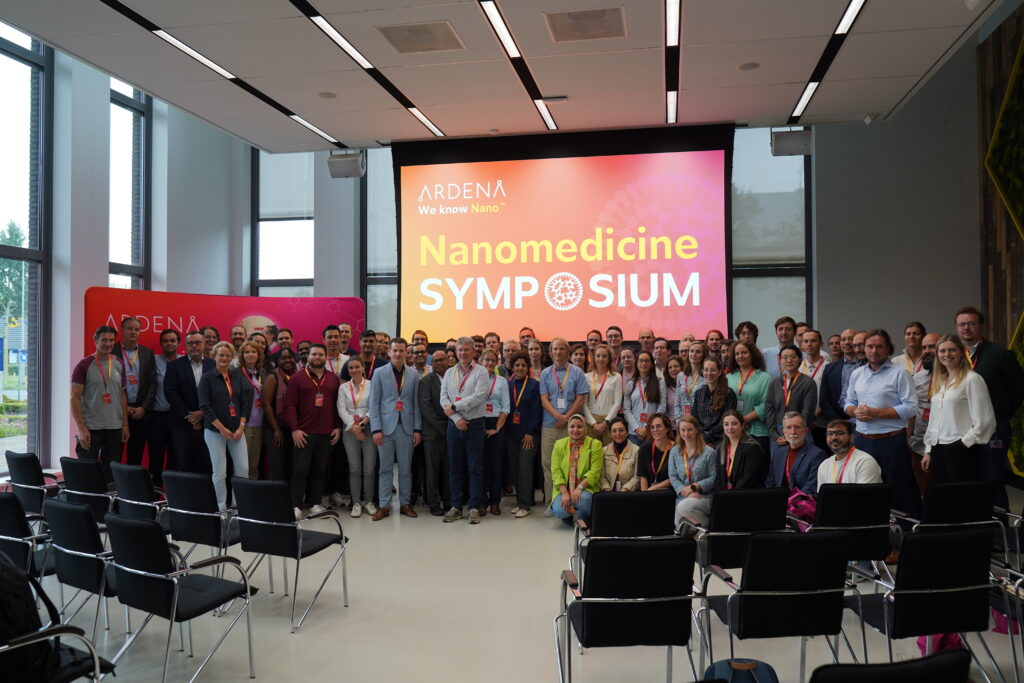
During the recent inaugural Nanomedicine and Bioconjugation Symposium, Ardena leadership outlined how QbD, balanced analytics, and tailored development pathways are leading the sector towards commercial escape velocity.
Nanomedicines and bioconjugate therapeutics represent a promising frontier in precision medicine, offering targeted delivery for complex payloads. However, transitioning these intricate projects from early discovery into robust, commercially viable drug products is challenging.
While a significant number of nanomedicines and bioconjugates enter clinical trials, the number reaching commercial approval remains limited, revealed Dr. Mark van Eldijk, Vice President of Science and Technology, Ardena, in an interview during the recent Nanomedicine and Bioconjugation Symposium, hosted in Oss, The Netherlands (1). “I truly believe we are at an inflection point where innovators can learn from one another,” he added. “Many developers face similar hurdles time and again, so, we wanted to create a forum where clients could see practical strategies they can apply directly to their programs.”
Building on those sentiments, Jeremie Trochu, CEO, Ardena, noted that creating a technology-focused industry forum where people can share challenges and explore different strategies is essential. “There is no single ‘right way’ innovators must navigate different constraints,” he said. “Helping the industry realize the full potential of nanomedicines is exciting.”
Overcoming Commercial Bottlenecks
Delving into the limited commercial availability of nanomedicines and bioconjugate drugs a little further, Dr. van Eldijk explained that there can be several factors that can have an impact. “Funding and investor dynamics play a major role,” he stated. “Development timelines sometimes move slower than sponsors anticipate, forcing companies to take a step back before proceeding. While that does not mean a program is canceled, it often just means clinical progress is delayed.”
These factors are why Dr. van Eldijk believes the sector is at an inflection point. “While relatively few of the hundreds of candidate programs have reached the market, there are still many approved therapies demonstrating success,” he asserted.
By way of example, Dr. van Eldijk pointed to the antibody-drug conjugate (ADC) market, which currently has more than 15 approved therapies. “ADCs share a more consistent structural framework compared to the broader nanoparticle landscape, but we are now seeing innovators bridge that gap through novel combination platforms,” he said.
Additionally, the accelerated timelines experienced during the pandemic reset the industry’s expectations to some degree, Trochu emphasized, highlighting that standard drug development takes time. “Despite scientific, technological, and regulatory advancements, navigating complex formulations and the scaling of complex manufacturing processes remains a multi-year journey,” he specified.
“That said,” Trochu continued, “commercial products are reaching the market, we are seeing that inflection point arrive. “Drug development remains a long-cycle process where quality is non-negotiable. The ADC space took time to reach ‘escape velocity’ before becoming an established, mature modality. Nanomedicines are entering that same growth phase now, with mRNA-LNPs paving the way alongside emerging polymer- and metal-based systems.”
Furthermore, the investment trends have cycled from one extreme to the other, particularly with the increased levels of investment seen during the pandemic and then the drop that has been seen afterwards. “Like many market cycles, there was an initial overshoot in one direction, followed by a correction in the other,” Trochu said. “The second half of 2024 felt like the bottom of the trough, followed by a gradual recovery over the past 18 months.”
Funding is returning for high-quality assets that meet unmet clinical needs with proven or de-risked technologies, Trochu commented. Funding naturally trickles back from lower-risk to higher-risk assets — Phase III funding never truly dried up, Phase II is accelerating, and early-stage capital is starting to follow, he added.
A Foundation in Quality
Focusing on quality-by-design (QbD), which is a cornerstone of modern drug development, Dr. van Eldijk emphasized that it forms the foundation of the development framework for nanomedicines. “We frequently use design of experiments (DoE) approaches to evaluate key parameters efficiently without needing to execute every condition across a full matrix,” he said. “While sponsors sometimes request accelerated timelines to reach the clinic faster, we ensure quality is never compromised. Deferring full process optimization can be a conscious, documented trade-off, provided it is done transparently and does not impact product quality or patient safety.”
In an ideal QbD scenario, formulation, manufacturing, and analytics are all fully optimized prior to a project entering clinical trials, making scale-up as straight forward as possible, Trochu stressed. “The reality is that sponsors operate under different constraints,” he remarked. “As long as it’s safe for the patient and within the regulatory framework, everything beyond that is a risk-based decision we make jointly with our clients.”
However, some aspects are non-negotiable, Trochu added. For example, the formulation needs to be stable to even enter the clinic, and while you may not need a final, commercial-scale manufacturing process in place on day one, it is important to establish a clear process development pathway early so a total redesign is not necessary later on, he noted.
“Analytical characterization is often the most underestimated aspect of complex formulation development,” Trochu stressed. “The complex interactions between a payload, carrier, and administration route — including dilution upon injection — require robust analytical methods. You cannot succeed with minimal analytical capabilities. When Ardena built its dedicated nanomedicine facility two years ago, we ensured the proper balance between analytical development, process development, and GMP manufacturing space.”
Future Outlook
Wrapping up the interview, Dr. van Eldijk revealed that to successfully develop a modern nanomedicine, it is important to have deep scientific understanding combined with hands-on experience across multiple delivery modalities. “Because so many platforms encounter similar manufacturing and analytical hurdles, leveraging cross-modality experience is key to advancing these complex products through clinical trials to regulatory approval,” he said.
“Success starts with sound science, enabled by disciplined, quality-driven drug development,” Trochu summarized.
Looking ahead to the potential future symposia, Trochu revealed the plans to focus on the intersection between technical formulation design, advanced bioanalytics, and clinical relevance. “Ensuring that complex formulation choices directly serve clinical outcomes is how we will continue pushing the boundaries of precision medicine,” he concluded.
Reference
1. Ardena. Nanomedicine & Bioconjugation Symposium 2026. Sept. 15–16, 2026.
Image Credit: © Studio-FI – stock.adobe.com